Before Carpenter’s Nightmare: The 1951 Thing That Was Literally a Killer Plant
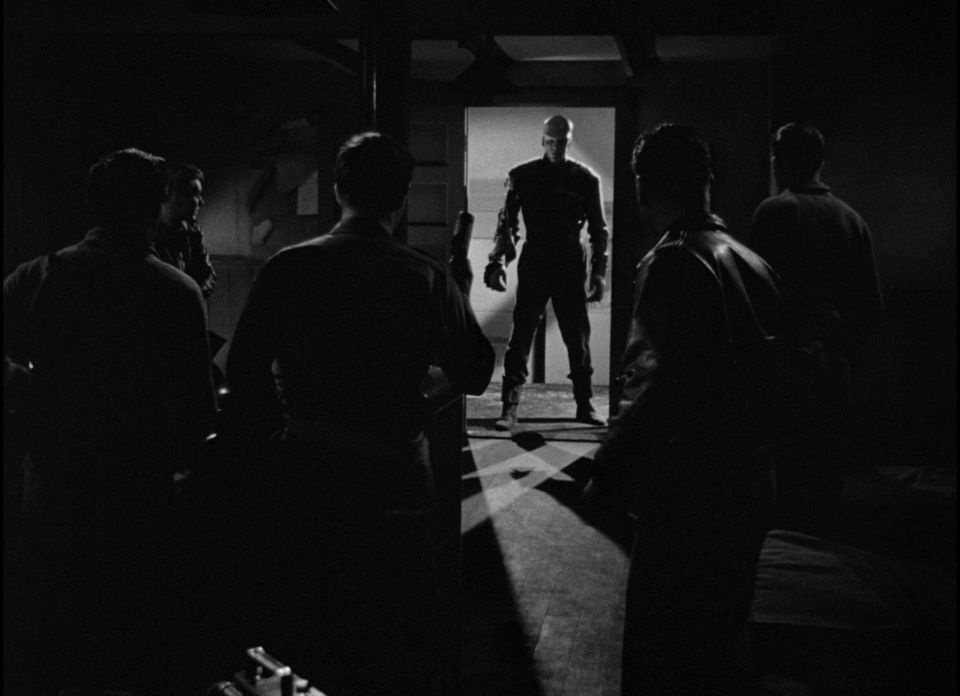
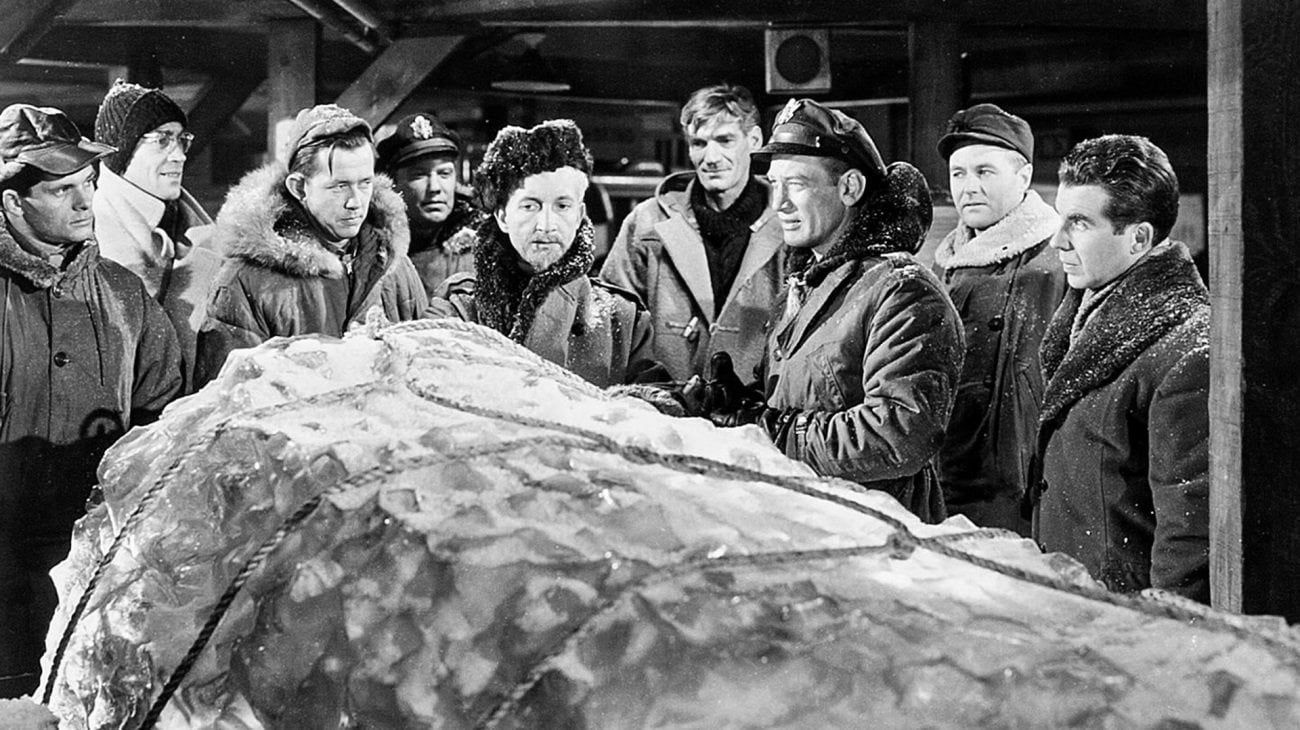
The Thing from Another World (1951) is a Cold War–era science-fiction movie directed by Christian Nyby and produced/co-written by Howard Hawks, adapted from the 1938 novella Who Goes There? by John W. Campbell Jr. The film centers on an Arctic research team that discovers an alien crash site, and it treats the creature as an external, mostly unseen threat rather than a shapeshifting internal menace.
Background and origin
The movie was released in 1951 and is often cited as one of the early postwar creature features. It is based on the novella Who Goes There? (1938) by John W. Campbell Jr., which has inspired multiple film adaptations. Howard Hawks is credited as a writer and producer, while Christian Nyby is credited as director. Moreover, contemporary accounts and later discussion note Hawks’ heavy creative influence on the production.
How it differs from John Carpenter’s 1982 The Thing
First, the 1951 film treats the alien as a plant-based life-form that feeds on blood, and it is portrayed mostly as an external menace. By contrast, John Carpenter’s 1982 film stays closer to Campbell’s text and depicts a grossly shapeshifting organism that assimilates victims and creates paranoia inside the group.
Second, the 1951 film rarely shows the creature in detail; when it is visible, the effect is a man-in-a-suit typical of the era. Carpenter’s version uses practical effects and make-up to emphasize body horror and internal threat. Therefore, the two movies use the same basic premise but pursue very different cinematic goals.
Cast, themes, and key moments
Key cast members include Kenneth Tobey as Air Force Captain Pat Hendry, Robert Cornthwaite as Dr. Carrington, Margaret Sheridan as the base’s secretary, Douglas Spencer as a reporter, and James Arness credited as the Thing. The film sets up a debate between military practicality and scientific curiosity: Hendry favors destroying the creature to protect lives, while Dr. Carrington argues for study and understanding.
In addition, the movie emphasizes suspense and the unknown rather than gore. It features a voice of public alarm in one of its memorable lines: “Watch the Skies!” That line captures the film’s Cold War atmosphere and its fear of an unstoppable external force.
Style and tone
The film builds tension through unseen threat and group dynamics. Furthermore, it displays a mix of skepticism and optimism: characters argue, but they work together using consensus, ingenuity, and debate to survive. Critics and film historians often point to the movie’s Hawkesian moral humanism and postwar concerns about outside threats.
Where to watch
The 1951 film is available to stream for free on Tubi and Roku, and it can be rented or purchased on major platforms.
You can watch it on Tubi or on Roku at no cost. Alternatively, the movie is available to buy or rent on Amazon and on Apple TV.